You have one glass of wine and your cheeks go red. Your face feels warm, your heart beats a little faster, and maybe you get a headache or feel slightly queasy. If this sounds familiar, you are experiencing what doctors call alcohol flush reaction. It is common, it is well understood, and there is a clear biological explanation for it. This guide walks through what is actually happening inside your body, and what the research says you can do about it. Key science claims are supported by linked sources.
Quick Answer
A red face after drinking is called alcohol flush reaction. It happens when your body cannot break down a compound called acetaldehyde fast enough. Acetaldehyde is a toxic byproduct your body produces as it processes alcohol. When it accumulates, it triggers histamine release and causes blood vessels in your skin to widen, which produces the visible flush along with a racing heartbeat, warmth, and sometimes nausea. For many people, the cause is a genetic variant in the ALDH2 gene that makes the enzyme responsible for clearing acetaldehyde less efficient.
What actually happens in your body
When you drink alcohol, your body breaks it down in two steps.[1]
Step one: An enzyme called alcohol dehydrogenase (ADH) converts the ethanol in your drink into a compound called acetaldehyde. Acetaldehyde is toxic, and it is the real troublemaker in this whole process.
Step two: A second enzyme called aldehyde dehydrogenase 2 (ALDH2) converts acetaldehyde into acetate, a substance your body clears more easily.
In most people, step two happens quickly enough that acetaldehyde never builds up. But in some people, the second enzyme works slowly, and acetaldehyde accumulates in the bloodstream faster than the body can clear it. That accumulation is what produces the red face. Acetaldehyde triggers the release of histamine, which causes the blood vessels near your skin to widen, a process called vasodilation. The result is visible redness, warmth, a faster heartbeat, and sometimes a headache or nausea.[2]
In short: the red face is not the problem itself. It is a visible signal that your body is working hard to process acetaldehyde.
Why some people flush and others do not
The most common reason for a slow second step is a genetic variant in the ALDH2 gene, known as ALDH2*2, also written as rs671. This variant produces a less efficient version of the ALDH2 enzyme. Research published in Nature Communications in 2024 reports that people with one copy of the variant retain roughly 10 to 45 percent of normal enzyme activity, while people with two copies retain only 1 to 5 percent.[3] The less enzyme activity you have, the more acetaldehyde builds up, and the stronger the flush.
This is genetic, which is why the reaction tends to run in families and why some people flush while their friends do not. It is not an allergy, it is not a sign of weakness, and it is not something you did. It is simply how your particular version of the enzyme works.
You may have heard this called “Asian glow.” The ALDH2*2 variant is most common in people of East Asian descent, so the reaction is sometimes referred to by that nickname. Peer-reviewed research reports the variant is present in roughly 30 to 50 percent of the East Asian population, compared to less than 5 percent of people of European ancestry.[3] That said, the reaction can occur in anyone, the underlying biology is the same regardless of background, and the medical name is simply alcohol flush reaction.
Common symptoms of alcohol flush reaction
The reaction varies in intensity from person to person and even from one drink to the next. The most commonly reported symptoms include:
- Redness of the face, neck, and chest
- A warm or burning sensation in the skin
- Rapid heartbeat or heart palpitations
- Headache
- Nausea
- Congestion or a stuffy nose
- Feeling intoxicated faster than the people around you
Symptoms usually appear within minutes of starting to drink and can last for an hour or two, depending on how much you drank and how quickly your body can clear the acetaldehyde.
How long does the red face last?
The visible flush typically fades within one to two hours after your last drink, but this varies based on how much you drank, how fast, what you ate beforehand, your body weight, and your individual enzyme activity. It is worth knowing that the acetaldehyde itself can linger in your system longer than the redness on your skin, which is one reason a headache or general fatigue can outlast the visible flush.
Should you use Pepcid to stop the redness?
One popular shortcut is taking famotidine, the active ingredient in Pepcid, before drinking to reduce the visible redness. It is widely discussed online. Here is the honest answer.
Pepcid is an H2 blocker, an over-the-counter heartburn medication. It can reduce the visible flush by blocking the histamine pathway that causes the skin redness. It does not change the underlying acetaldehyde buildup. In other words, it hides the signal without addressing the cause.
The USC School of Pharmacy has specifically cautioned against this practice. Dr. Daryl Davies, Director of the Alcohol and Brain Research Laboratory at USC, has explained that using H2 blockers to mask the flush can lead people to drink more than their body can comfortably process, which is associated with elevated long-term health risks.[4] The National Institute on Alcohol Abuse and Alcoholism echoes this caution.[5]
We do not recommend using Pepcid or any H2 blocker to mask alcohol flush before drinking. If you choose to use any medication off-label, talk to your physician first.
Ingredients researchers have studied
Several supplement ingredients have published research on their roles in the body’s natural alcohol metabolism pathway. None of these change your genetics or the underlying enzyme activity. Here is what the research actually says.
Dihydromyricetin (DHM)
DHM is a flavonoid from the Japanese raisin tree, Hovenia dulcis, with a long history in traditional East Asian wellness practice. A widely cited 2012 paper in the Journal of Neuroscience by Shen and colleagues at UCLA documented that DHM affects how alcohol acts on GABA-A receptors in rats.[6] Later animal research has reported that DHM may support hepatic ADH and ALDH activity and reduce serum acetaldehyde in mice.[7] Human clinical data on isolated DHM remains limited.
N-acetyl cysteine (NAC)
NAC is a precursor to glutathione, the body’s principal antioxidant, which is involved in clearing acetaldehyde-related oxidative stress. NAC has a long history of use in dietary supplements. The U.S. Food and Drug Administration issued final guidance on August 1, 2022 confirming its intent to exercise enforcement discretion for NAC-containing dietary supplements.[8]
L-cysteine
L-cysteine is the amino acid that NAC is built from. Salaspuro and colleagues reported in a 2002 peer-reviewed paper that a slow-release buccal L-cysteine tablet reduced salivary acetaldehyde by approximately 59 percent compared to placebo.[9] The mechanism is direct: L-cysteine can bind acetaldehyde to form a more stable compound.
Milk thistle (silymarin)
Silymarin, the active complex in milk thistle, has been studied for liver support. Bioavailable forms such as Siliphos® pair silybin with phosphatidylcholine to support absorption.[10]
How to reduce a red face from drinking
There is no way to change the enzyme you were born with, but there are sensible, research-aligned steps that can reduce the severity of the reaction.
1. Drink less, and drink more slowly
This is the single most effective step. A healthy liver clears roughly one standard drink per hour. Drinking faster than that means acetaldehyde builds up no matter what else you do. Less alcohol means less acetaldehyde, which means less flush.[1]
2. Eat before you drink
Food in your stomach slows alcohol absorption, giving your enzymes more time to keep up. A meal with protein and healthy fats beforehand makes a real difference.
3. Hydrate
Alcohol is a diuretic, meaning it pulls fluid from your body. A glass of water between each drink supports normal hydration and can help with the headache and fatigue that sometimes accompany the flush.[11]
4. Choose your drinks carefully
Clear spirits such as vodka and gin tend to contain fewer congeners than dark spirits such as whiskey and brandy, as well as red wine. Congeners are fermentation byproducts that can make symptoms feel worse.[11]
5. Consider a research-informed pre-drinking supplement
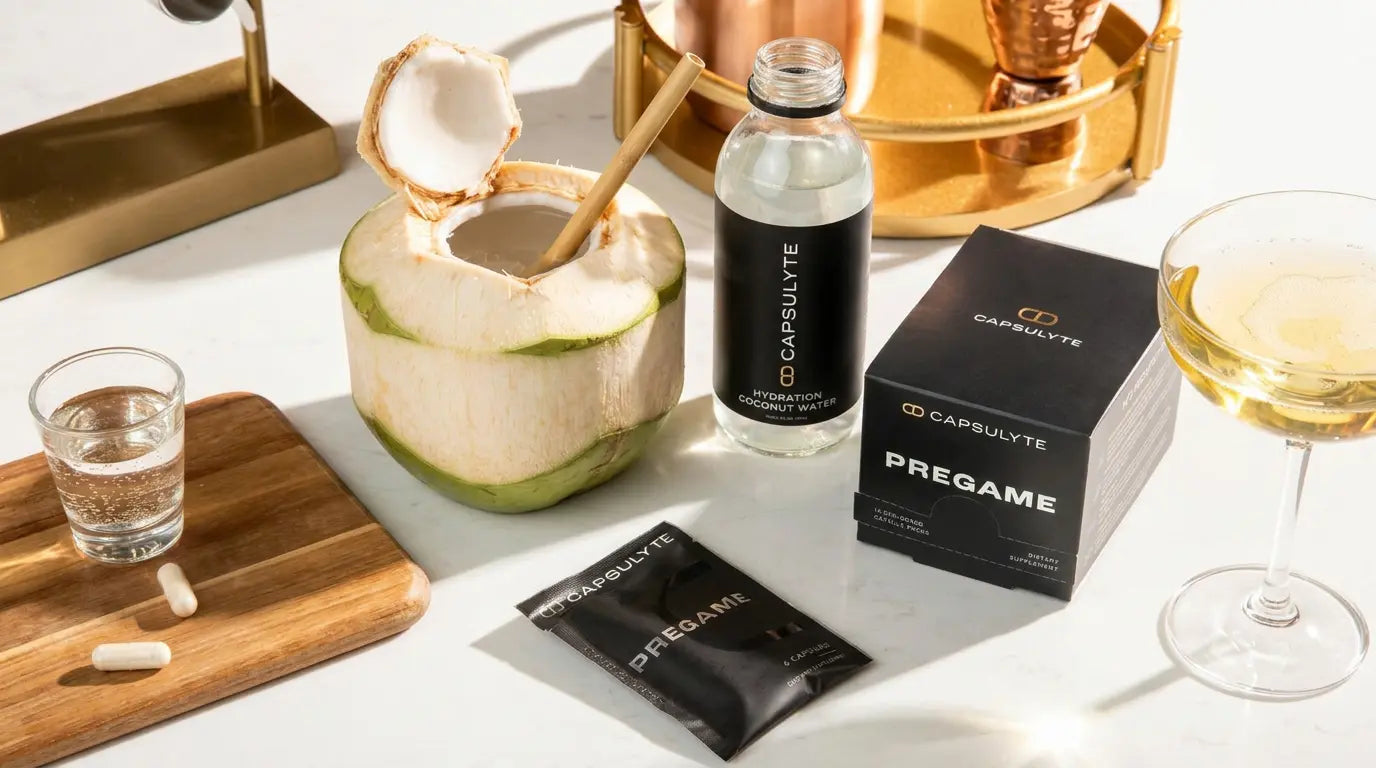
If you choose to use a supplement, look for one with ingredients that have published research, such as DHM, NAC or L-cysteine, and standardized milk thistle, formulated by a credentialed practitioner. Capsulyte PREGAME combines these ingredients in a single pre-drinking capsule and was formulated by Dr. Dan Nguyen, MD, MBA. PREGAME is intended to support your body’s natural alcohol metabolism pathway. It is not a treatment for any condition.
6. Talk to your physician
If you flush significantly every time you drink, it is worth a conversation with your doctor. They can talk through what makes sense for your individual situation and flag any medications that might interact.
References
- Zakhari S. “Overview: How Is Alcohol Metabolized by the Body?” Alcohol Research and Health. 2006;29(4):245-254. PMID: 17718403. View source
- National Institute on Alcohol Abuse and Alcoholism (NIAAA). “Alcohol Flush Reaction: Does Drinking Alcohol Make Your Face Red?” View source
- Wang B et al. “The aldehyde dehydrogenase 2 rs671 variant enhances amyloid beta pathology.” Nature Communications. 2024. PMC10959958. View source
- USC Health Sciences News. “Antihistamines prevent ‘Asian flush’ but with huge risks.” Featuring Daryl Davies, PhD. View source
- National Institute on Alcohol Abuse and Alcoholism (NIAAA). “Alcohol Flush Reaction.” View source
- Shen Y, Lindemeyer AK, Gonzalez C, Shao XM, Spigelman I, Olsen RW, Liang J. “Dihydromyricetin As a Novel Anti-Alcohol Intoxication Medication.” Journal of Neuroscience. 2012;32(1):390-401. PMID: 22219299. View source
- Silva J et al. “Dihydromyricetin Protects the Liver via Changes in Lipid Metabolism and Enhanced Ethanol Metabolism.” Alcoholism: Clinical and Experimental Research. 2020;44(5):1046-1060. PMC7211127. View source
- U.S. Food and Drug Administration. “Policy Regarding N-acetyl-L-cysteine: Guidance for Industry.” Final guidance issued August 1, 2022. Docket No. FDA-2022-D-0490. View source
- Salaspuro V et al. “Removal of acetaldehyde from saliva by a slow-release buccal tablet of L-cysteine.” 2002. PMID: 11774289. View source
- Méndez-Sánchez N et al. “Superior silybin bioavailability of silybin-phosphatidylcholine complex in oily-medium soft-gel capsules versus conventional silymarin tablets in healthy volunteers.” BMC Pharmacology and Toxicology. 2019;20:5. View source
- National Institute on Alcohol Abuse and Alcoholism (NIAAA). “Hangovers.” View source